Choosing the right lithium battery recycling plant is not only about capacity or price. For investors, recyclers, and battery waste processors, the real challenge is whether the system can safely handle different battery chemistries, recover valuable materials efficiently, and meet long-term environmental requirements. NMC, LFP, and LCO batteries have different material values, safety risks, and recycling focuses, so the recycling line should be selected according to your feedstock, output target, and project scale.
Understand Your Battery Types First
Before buying a lithium battery recycling plant, you need to confirm what kind of batteries you will process. NMC batteries usually contain nickel, manganese, cobalt, lithium, copper, aluminum, and graphite. They have higher metal recovery value, so the recycling line should focus on black mass purity and metal separation efficiency.
LFP batteries contain lithium iron phosphate. Compared with NMC, they usually have lower cobalt and nickel value, but they are widely used in EVs, energy storage systems, and electric buses. For LFP battery recycling, stable crushing, safe dust collection, and efficient black mass recovery are very important.
LCO batteries are commonly used in consumer electronics. They may have higher cobalt content, but the battery size, shell type, and feeding form can be more mixed. Therefore, the plant needs flexible pretreatment and sorting design.
Check the Safety Design of the Recycling Line
Safety should be the first factor when choosing a lithium battery recycling machine. Waste lithium batteries may still contain electricity, electrolyte, flammable gas, and dust. A professional recycling plant should include discharge treatment, sealed crushing, negative pressure dust collection, fire prevention design, and gas treatment system.
For mixed NMC, LFP, and LCO batteries, the crushing and separation section should be designed with explosion prevention, temperature monitoring, and emergency protection. This helps reduce fire risk and keeps the whole recycling process more stable.
Focus on Final Output Quality
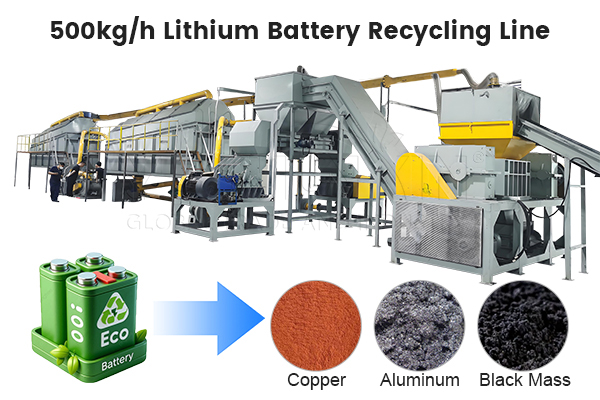
Different buyers may require different final products. Some want high-purity black mass. Some want separated copper, aluminum, iron, plastics, and diaphragm materials. When choosing the plant, you should ask clearly about the recovery process, separation accuracy, dust control system, and final material purity.
If your main goal is selling black mass to downstream hydrometallurgy factories, then black mass purity and metal impurity control are key. If you want more material categories, the line should include magnetic separation, air separation, screening, and fine collection systems.
Choose Capacity Based on Real Feedstock Supply
Do not choose a large-capacity lithium battery recycling plant only because it looks more profitable. A 300–500 kg/h line may be suitable for pilot projects or regional collection centers. A 1000 kg/h or larger line is more suitable for stable industrial battery waste supply. The best choice depends on your daily battery collection volume, labor plan, workshop space, environmental approval, and budget.
Work with an Experienced Manufacturer
A reliable manufacturer should not only provide machines, but also help you design the full process according to battery type, capacity, safety level, final output, and local environmental requirements. YUSHUNXIN specializes in solar panel and lithium battery recycling equipment manufacturing, with equipment development, production, and sales capabilities.
For NMC, LFP, and LCO battery recycling projects, the right plant should be safe, flexible, efficient, and scalable. Before making a decision, compare not only price, but also process design, safety configuration, output quality, after-sales support, and long-term operating cost. Visiting: https://www.solutionsforewaste.com/product/lithium-battery-recycling-machine-price/
Leave a Reply