Choosing the right capacity is one of the most important decisions when investing in a solar panel recycling plant. While both 500 kg/h and 1000 kg/h recycling lines are widely used in the industry, their profitability depends on factors such as feedstock supply, operational efficiency, and market demand. A higher capacity does not automatically guarantee higher profit—it must align with real processing needs and business strategy. At YUSHUNXIN, we manufacture solar panel recycling equipment designed to help clients select the most suitable capacity for stable and scalable returns. Understanding the design and layout considerations for a 500kg/h line provides a useful benchmark for evaluating space and workflow requirements.
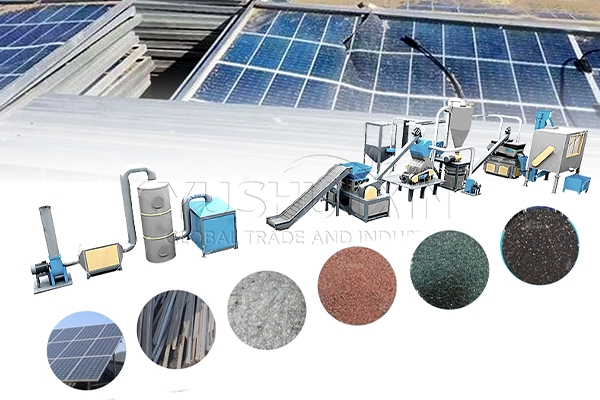
Investment Cost vs Processing Capacity
A 500 kg/h recycling line typically requires lower initial investment, making it suitable for startups or facilities entering the solar recycling sector. It allows operators to control capital expenditure while establishing stable operations. For a detailed look at what drives these costs, reviewing the key factors in solar recycling machine prices helps in accurate budget planning.
In contrast, a 1000 kg/h system involves higher upfront cost due to larger equipment, enhanced automation, and increased infrastructure requirements. However, it offers greater throughput, which can reduce the processing cost per ton when operating at full capacity.
The key is balancing investment with actual material availability to avoid underutilized capacity.
Throughput and Revenue Potential
Higher capacity systems generate greater output within the same time frame, directly increasing potential revenue from recovered materials such as glass, aluminum, and copper. A 1000 kg/h line can process nearly double the volume of a 500 kg/h system, which can significantly improve total revenue if sufficient feedstock is available. Advanced processes like efficient copper recovery from retired solar panels add substantial value regardless of line size.
However, if raw material supply is inconsistent, a smaller system may achieve higher efficiency rates and better cost control, leading to more stable profitability. The purity of recovered materials directly impacts their market value, making separation quality a critical factor.
Operational Efficiency and Cost Control
Operational costs—including labor, energy consumption, and maintenance—scale differently with capacity. While a 1000 kg/h system consumes more energy overall, its energy cost per ton is often lower due to higher efficiency and optimized process flow.
YUSHUNXIN solar panel recycling equipment integrates frame removal and glass separation at the front end, reducing downstream load and improving overall efficiency for both capacity levels. Automated systems further reduce labor requirements, helping maintain consistent operational performance.
Flexibility and Scalability
A 500 kg/h system offers greater flexibility for businesses with variable feedstock supply or limited initial investment. It can also serve as a foundation for gradual expansion. For facilities handling diverse panel types, exploring a double-glass PV panels recycling solution ensures compatibility with newer module designs.
A 1000 kg/h system is better suited for established operations with stable supply chains and long-term processing contracts. Its higher capacity supports large-scale, continuous production and faster revenue generation.
Choosing the Right Path to Profitability
Profitability depends not only on capacity but on how well the system matches business conditions. A properly utilized 500 kg/h line can be more profitable than an underutilized 1000 kg/h system.
As a manufacturer of solar panel recycling equipment, YUSHUNXIN focuses on delivering reliable, efficient, and scalable solutions tailored to different operational needs. By aligning capacity with feedstock availability and market demand, businesses can achieve sustainable and predictable returns in solar panel recycling.
For insights into how policy developments are shaping capacity planning decisions, read about new regulations boosting investment in PV recycling lines.
Leave a Reply