The rise of end-of-life photovoltaic (PV) panels has turned solar recycling into a fast-growing, eco-friendly business opportunity—driven by strict landfill regulations and the value of recoverable materials like aluminum, glass, copper, and silver. Mastering the streamlined solar panel recycling process is key to turning waste into sellable commodities while meeting environmental compliance. This step-by-step breakdown outlines the core industrial workflow, optimized for small to mid-scale operations and maximum material recovery.
Pre-disassembly
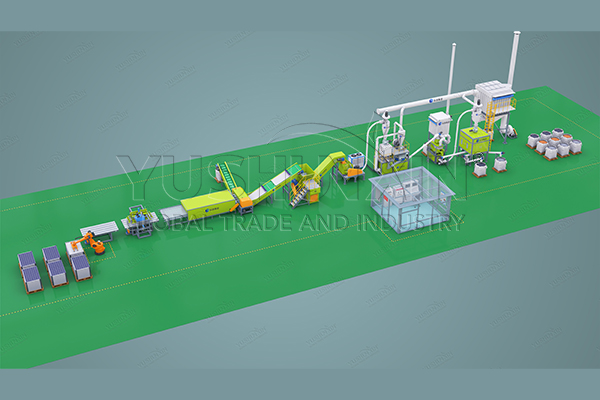
The process begins with pre-disassembly, the foundational step to cut contamination and boost downstream efficiency. First, an automated frame-removal station detaches aluminum frames—one of the easiest and most valuable materials to recover, with a direct resale path to scrap dealers and smelters. Next, junction boxes are removed to eliminate plastic and copper contamination, ensuring pure material separation in later stages. This manual or semi-automated step is low-cost and critical: clean aluminum frames command higher market prices, and removing junction boxes prevents equipment damage in shredding.
Primary shredding/crushing
After disassembly, the panel laminate (glass, EVA encapsulant, silicon cells, and backsheet) moves to primary shredding/crushing—the heart of mechanical recycling. A heavy-duty shredder breaks the laminate into small, manageable pieces, making separation feasible. This stage requires dust and noise control systems, as fine glass and polymer particles pose worker safety risks and require filtration to meet air emission standards. For operations processing thin-film panels, additional pre-shredding controls are needed to handle hazardous constituents and avoid cross-contamination.
Multi-stage separation
The shredded material then enters multi-stage separation, where specialized equipment isolates distinct materials. Magnetic separators pull out ferrous metals, while eddy current separators extract non-ferrous metals like copper—critical for recovering wiring and conductive components. Air classification and screening sort glass particles from plastic and EVA encapsulant fractions, and sieves separate fine glass cullet from larger silicon-rich pieces. For businesses targeting higher-value glass (e.g., for glass recyclers), this stage must be calibrated for purity: clean, uncontaminated glass cullet has a far higher market value than mixed fractions.
Delamination or thermal treatment
For operations aiming to unlock more value, delamination or thermal treatment is an optional (yet impactful) next step. This process breaks down the EVA encapsulant bonding glass and silicon cells, enabling recovery of cleaner glass and silicon-rich fractions—materials that can be sold to PV manufacturers or specialized refiners. While this adds equipment and permitting costs, it significantly boosts profitability by turning low-value mixed fractions into high-purity commodities. Thin-film panel processing often requires this step to separate toxic materials and meet strict hazardous waste regulations.
Material grading and sales channel alignment
The final stage is material grading and sales channel alignment—the key to turning recovered materials into revenue. Aluminum frames and copper are sorted by purity and sold to scrap metal buyers; clean glass cullet is sent to glass recyclers; and silver-rich silicon fractions are sold to precious metal refiners. Mixed plastic and EVA fractions, while harder to monetize, can be sold to polymer processors if processed to a defined specification. The most successful recyclers identify buyers early, calibrate their separation equipment to match buyer purity requirements, and build consistent offtake contracts to stabilize profits.
Safety and compliance are non-negotiable
A critical note for all operations: safety and compliance are non-negotiable. From dust extraction and worker PPE to waste handling and air emission permits, every step must adhere to regional environmental and labor laws—especially for businesses processing thin-film panels with hazardous components. Most new recyclers start small, with a basic line of disassembly, shredding, and basic separation, then scale to delamination or thermal treatment as supply and sales channels stabilize.
Solar panel recycling is a scalable business that aligns with the growth of renewable energy. By following this streamlined process, investing in reliable separation equipment, and prioritizing material purity and compliance, you can turn PV panels from a waste stream into a consistent, profitable resource—all while contributing to a circular economy for the solar industry.
Leave a Reply