Choosing the right lithium battery recycling plant is not only about finding the lowest price. For most investors, the real goal is to build a recycling line that matches the feedstock, output requirements, safety standards, local regulations, and long-term operating budget. If you choose a system only by machine price, you may face low recovery efficiency, unstable operation, higher labor cost, or extra upgrade expenses later.
1. Start with Your Battery Raw Materials
Before asking for a quotation, you should clearly confirm what types of batteries you plan to recycle. Common materials include EV battery packs, e-bike batteries, energy storage batteries, cylindrical cells, pouch cells, aluminum shell batteries, and mixed lithium batteries such as NMC, LFP, and LCO.
Different battery types require different pretreatment designs. For example, full battery packs may need dismantling, discharging, shredding, crushing, separation, and dust collection. If your raw materials are already dismantled cells, the process can be simpler. Therefore, your feedstock condition directly affects the lithium battery recycling plant cost.
2. Choose the Right Capacity, Not the Biggest One
Capacity is one of the biggest cost factors. A small lithium battery recycling line may be suitable for testing, local collection centers, or pilot projects. A medium-capacity plant is better for companies with stable battery supply. A large industrial recycling line requires higher investment, larger workshop space, stronger safety systems, and more professional operation.
If your battery supply is not stable at the beginning, choosing a modular system may be more practical. You can start with a suitable capacity and reserve space for future expansion.
3. Focus on Safety Configuration
Lithium battery recycling involves dust, electrolyte residue, heat, and possible fire risks. A reliable plant should consider negative pressure operation, dust collection, fire prevention, explosion-proof design, temperature monitoring, and optional inert gas protection.
These safety systems will increase the initial budget, but they help reduce operating risks and make the whole project more acceptable for environmental approval and factory management.
4. Compare Final Output Value
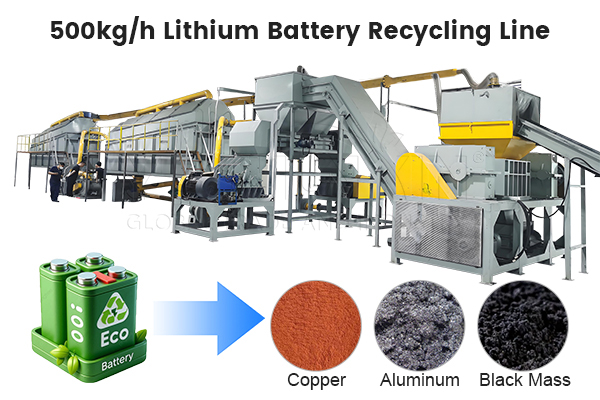
A good lithium battery recycling plant should not only crush batteries. It should help you obtain valuable outputs such as black mass, copper, aluminum, plastics, and other separated materials. The purity and separation effect will influence your selling price and profit potential.
Therefore, when comparing quotations, ask the supplier about the process flow, separation method, output types, power consumption, labor requirement, and environmental treatment system.
5. Leave Budget for Installation and Operation
Besides the recycling equipment itself, your total investment may also include workshop construction, foundation, electrical system, dust treatment, fire protection, installation, commissioning, spare parts, workers, and local permits. A realistic budget should cover both machine purchase and project operation.
Conclusion
The right lithium battery recycling plant should match your raw materials, target capacity, safety needs, final products, and investment plan. Instead of choosing the cheapest offer, you should choose a solution that can run stably, recover valuable materials, and support future business growth. For a more accurate quotation, you can share your battery type, daily processing capacity, final output requirements, factory size, and local environmental requirements with the recycling equipment manufacturer. Visiting: https://www.sxlbp.com/products/lithium-battery-recycling-machine-cost/
Leave a Reply