The cost of a solar panel recycling plant does not come from one machine alone. It mainly depends on three factors: the type of waste panels you process, the target capacity, and the final recovery goal. A buyer who only needs to recycle single-glass solar panels will usually choose a mechanical separation line, while a project handling mixed single- and double-glass panels may need a pyrolysis-based system with further metal and silver recovery. These two configurations differ greatly in equipment structure, land requirement, power demand, and total investment.
1. Panel Type Decides the Main Recycling Process
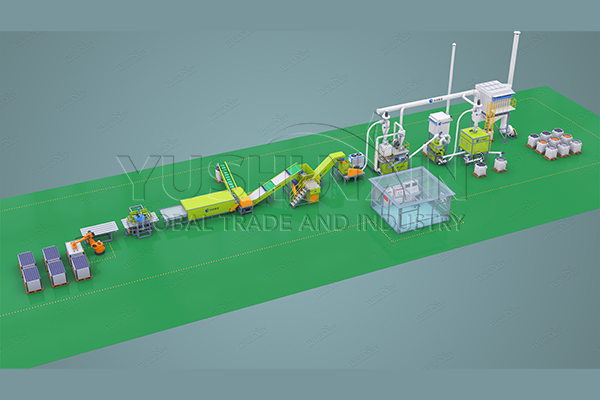
For single-glass solar panel recycling, a mechanical line is often suitable. The process can include aluminum frame removal, glass removal, shredding, hammer crushing, grinding, gravity separation, and electrostatic separation. YUSHUNXIN’s YSX-1000 mechanical solar panel recycling line has a processing capacity of 1 t/h, total power of 277.6 kW, and a land requirement of about 36 × 6 × 6 m. This kind of system focuses on recovering glass, copper, silicon powder, and plastic powder through physical separation.
For mixed single- and double-glass solar panels, the equipment configuration becomes more complex. A pyrolysis system can first remove EVA bonding material, then separate glass, silicon, copper, and silver through subsequent screening and extraction steps. Available reference models include 8 t/d and 16 t/d systems, with land requirements of approximately 50 × 30 × 8 m and 60 × 30 × 8 m respectively. As a result, this configuration usually requires a higher budget than a basic mechanical line.
2. Capacity Has a Direct Impact on Plant Price
Capacity is one of the most important cost drivers. A buyer planning a small or medium project may focus on a 1 t/h mechanical solar panel recycling machine, while larger recycling plants may require daily capacities of 8 t/d, 16 t/d, or more. Higher capacity generally means larger reactors or crushing systems, stronger motors, wider conveying systems, larger separation units, and a more demanding plant layout. Therefore, when asking for a quotation, buyers should first confirm the expected daily input volume and annual operating plan.
3. Configuration Determines the Final Investment
Two plants with similar capacity can still have very different prices. The final cost changes according to whether the system includes:
- Aluminum frame dismantling
- Glass removal
- Multi-stage crushing and grinding
- Gravity and electrostatic separation
- Pyrolysis furnace
- Gas purification and condensation system
- Silver extraction equipment
- Environmental protection and safety devices
For pyrolysis-based solar panel recycling, furnace size, discharge structure, condensation setup, and safety configuration all influence the overall equipment cost. Solar panel pyrolysis also requires more sustained external heating than tire or plastic pyrolysis, which means buyers should consider not only machine price but also long-term operating costs.
4. Buyers Should Compare Cost With Recovery Value
A lower initial quote is not always the better choice. Buyers should evaluate whether the plant can match their target panel type, recovery products, operating efficiency, and local compliance needs. For example, if the goal is only to process single-glass panels and recover common materials, a mechanical recycling line may be more practical. If the project aims to treat mixed panels and further recover silver with higher purity, a pyrolysis and silver extraction configuration may better support long-term value. The silver recovery section can include rough extraction and refining, with the document showing reference outputs of 90% rough silver and 99.99% silver ingot after refining.
Conclusion
So, how much does a solar panel recycling plant cost? The answer depends on the exact project design. A reliable quotation should be based on panel type, target capacity, desired recovered materials, plant layout, and environmental configuration. YUSHUNXIN can provide solar panel recycling solutions from mechanical separation systems to pyrolysis-based recycling lines, and its related solar panel and e-waste recycling equipment models are covered by CE conformity documentation. Visiting: https://www.solutionsforewaste.com/product/solar-panel-recycling-plant-cost/
Leave a Reply