A solar panel recycling plant improves waste utilization for industrial companies when its throughput capacity matches the flow of damaged, replaced and end-of-life modules. The solar panel recycling plant throughput capacity connects receiving, dismantling, thermal delamination, crushing, screening, separation and product dispatch. waste hierarchy principles prioritize recovery before disposal, but the plant must prove that each recovered fraction meets a real buyer specification. Industrial sites benefit when the recycling line accepts their module waste and returns clean aluminium, glass, copper and silver-bearing residue to useful markets. The capacity plan must also cover seasonal collection and storage, because a line designed only for average volume can become a bottleneck during a large retrofit.
Which feedstock conditions determine solar panel recycling plant throughput capacity?
Module size, frame type, glass composition and condition affect the speed of dismantling and delamination. A industrial waste utilization from solar panel recycling measures typical batches and sets a capacity target for each mix rather than one ideal module. Damaged panels may require separate storage and more careful handling, while frameless modules change the preparation step. The plant also estimates the share of glass, metal and silver-bearing fines that the separation equipment can recover. Operators record incoming mass and output by shift to compare actual throughput with design. Realistic feedstock data protects the industrial user from a line that meets its nameplate only under favorable conditions.
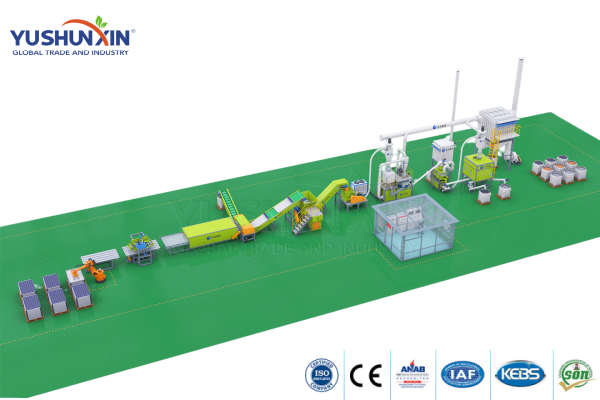
How does the material separation train increase value from industrial PV waste?
Frame removal and junction-box separation prepare valuable metal fractions before thermal treatment. A PV recycling throughput for industrial companies keeps glass and residue in separate streams and controls dust at the crusher and conveyor transfers. The related solar panel recycling equipment cost factors analysis helps the owner compare equipment cost with expected recovery and capacity. Operators inspect screens, belts and separation settings because a small change can contaminate a product stream. The plant stores each output in a labeled container and keeps samples for buyer approval. Better separation improves sale value and reduces the volume that the industrial company sends to disposal, which creates both revenue and measurable waste utilization.
Which utility and maintenance factors sustain high throughput for an industrial recycling line?
Thermal delamination consumes significant energy, while fans, conveyors, crushers and dust collectors set the electrical load. The plant needs a reliable power supply, adequate cooling and a maintenance plan for heating elements, filters, belts and screens. The operator monitors pressure drop and motor current to detect a developing blockage. Spare parts for critical components stay on site, and maintenance crews receive access to every service point. A line that runs at stable throughput uses labour and energy more efficiently than a larger line with frequent short stops. The industrial site can schedule collection campaigns around planned maintenance and avoid accumulating modules beyond its storage limit.
Which metrics prove that a solar panel recycling plant improves industrial waste utilization?
The plant records total panel input, recovered product mass, residue, energy use and hours of operation. The industrial company compares those figures with its previous disposal volume and cost. A monthly report shows the recovery rate by material and the share sold to local buyers. The team also tracks contamination and customer acceptance, because a high recovery rate has little value if the output requires extra processing. The owner reviews downtime causes with maintenance and adjusts collection schedules when necessary. These measurements show whether the recycling line turns PV waste into useful material and whether its capacity matches the industrial site’s real flow.
Conclusion for industrial companies and PV recycling operators
A solar panel recycling plant supports industrial waste goals when feedstock, separation, utilities and product buyers align with the design throughput. The operator needs measured module input, high-quality output and a maintenance plan that protects availability. A industrial PV recycling advisors that reviews the mass balance and equipment layout helps the industrial company choose a suitable capacity. Tracking residue and buyer acceptance proves the real value of the recycling route. The solar panel recycling line reference appears at https://www.spdsx.com/product/solar-panel-recycling-line/ for the next feasibility review.