The cost of a lithium battery recycling plant is shaped by more than processing capacity. A 500kg/h line and a 1000kg/h line differ in equipment scale, installed power, workshop space, environmental protection systems, and automation demand. As a manufacturer of lithium battery recycling equipment, YUSHUNXIN recommends evaluating the full plant configuration rather than comparing only a single machine price.
500kg/h Recycling Plant: Lower Entry Pressure, Complete Processing Logic
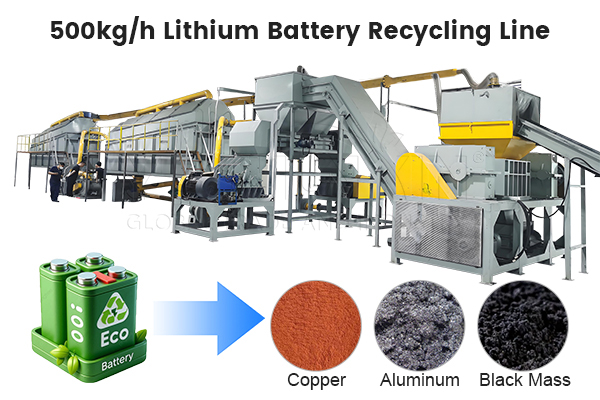
A 500kg/h lithium battery recycling line is often suitable for customers starting a medium-scale recycling project, building a new plant, or testing local waste battery supply. According to YUSHUNXIN’s product brochure, this capacity is configured with about 300kW main power and requires an approximate floor area of 60m × 7m × 7m. The line is designed to process waste single lithium batteries and separate valuable outputs such as black powder, aluminum granules, copper granules, and other residual materials.
Its investment is usually easier to control because the plant scale, conveying distance, and supporting systems are smaller. However, the final quotation still depends on whether the customer needs discharge equipment, carbonization or drying treatment, refined metal separation, dust control, and additional gas purification. Getting a clear lithium battery recycling machine cost for this capacity requires specifying these add-ons upfront.
1000kg/h Recycling Plant: Higher Capacity Requires Stronger Supporting Systems
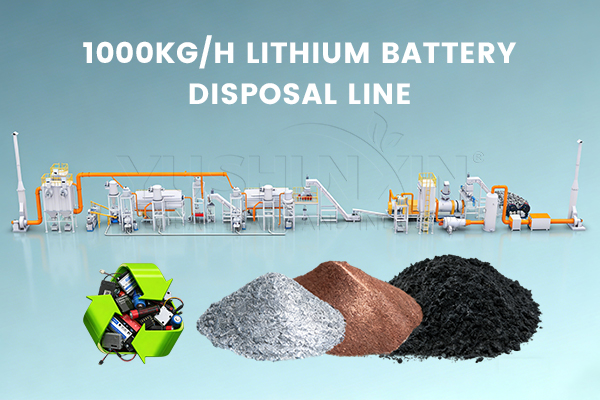
A 1000kg/h lithium battery recycling line is better suited for customers with a steadier battery supply and larger daily processing targets. YUSHUNXIN’s brochure lists this configuration at about 349kW main power with an approximate floor requirement of 80m × 7m × 7m.
The higher price of a 1000kg/h line does not come only from doubling capacity. It also reflects larger feeding and conveying systems, stronger crushing and separation capacity, more stable continuous operation, and more demanding workshop planning. For customers focused on long-term industrial production, this larger configuration may reduce future capacity bottlenecks. Understanding what a 1000kg per hour disposal line includes helps justify the additional investment through higher throughput.
What Factors Change the Final Plant Cost?
YUSHUNXIN’s current lithium battery recycling process planning includes discharge, shredding, drying or carbonization, screening, secondary crushing, secondary screening, grinding, and circular vibrating screening for both 500kg/h and 1000kg/h capacity levels.
Beyond capacity, price is also affected by:
- Raw battery type and material complexity
- Degree of automation
- Nitrogen protection and cooling design
- Dust collection, spray tower, activated carbon adsorption, and odor treatment
- Required purity of copper, aluminum, and black powder fractions
For example, the technical file describes negative-pressure dust collection, spray tower treatment, activated carbon adsorption, and UV photolysis as part of pollution-control design, while some separation systems also use nitrogen protection and water cooling. These configurations directly influence equipment investment and operating reliability. The recoverable materials from batteries recycling you aim for will determine how sophisticated your separation train needs to be.
Why Choose YUSHUNXIN for Cost Evaluation?
YUSHUNXIN does not recommend choosing a lithium battery recycling plant by capacity alone. A practical quotation should be based on battery type, expected throughput, workshop conditions, environmental requirements, and target recovered materials. By matching these factors carefully, customers can choose between a 500kg/h cost-controlled solution and a 1000kg/h higher-output solution with a clearer investment direction. For those handling EV packs specifically, exploring EV battery recycling projects provides additional context on how capacity selection aligns with automotive feedstock volumes.
Leave a Reply