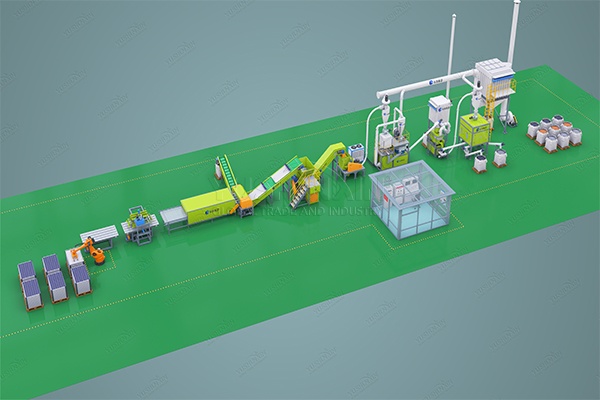
A 500 kg/h solar panel recycling machine (or complete recycling line) is typically positioned as a mid-to-high throughput solution for companies expecting steady feedstock from decommissioned PV modules, warranty returns, or large-scale repowering projects. The price can vary widely because “solar panel recycling machine” may describe anything from a single delamination unit to a full, integrated system that handles frame removal, junction box separation, glass recovery, cell/wafer processing, and dust control. In practice, what you pay is determined less by the headline capacity and more by the process steps included, the automation level, and the purity targets for recovered materials.
What Usually Drives the Cost Up (or Down)
Throughput is only one component. Higher cost often comes from advanced delamination (thermal, mechanical, or chemical-assisted), robust shredding and separation stages, and engineered air filtration to manage EVA fumes, glass dust, and fine particles. Automation features—such as robotic frame removal, automatic feeding, PLC controls, and real-time monitoring—can also push pricing upward but reduce labor needs and improve consistency. On the lower end, simpler lines may focus on bulk separation and volume reduction, producing mixed outputs that require additional downstream refining, which affects the real economics of the project.
Operating Costs and Revenue Potential
To decide whether it’s worth the investment, focus on total cost of ownership rather than purchase price alone. Electricity consumption, wear parts (blades, screens, seals), maintenance downtime, and compliance costs (filters, emissions permits, waste handling) can be significant. On the revenue side, recovered aluminum frames are usually the easiest and most reliable value stream. Glass can be profitable if it’s clean enough for reuse; otherwise, it may only have low-value outlet options. The most sensitive part of the business case is often the recovery of silver, copper, and silicon from cells—these can improve margins, but only if your process achieves sufficient purity and you have buyers or refiners lined up.
Is a 500 kg/h Line “Worth It” for Your Business?
A 500 kg/h system tends to make sense when you can secure predictable supply contracts, minimize inbound logistics costs, and operate at high utilization (not just occasional batches). If your region has producer responsibility regulations, landfill restrictions, or subsidies for recycling infrastructure, the investment case improves substantially. Conversely, if panel volumes are uncertain or your outputs lack a local market, a smaller modular system or a partnership model (processing and shipping concentrates to a specialist refiner) may be less risky.
How to Evaluate a Quote Like an Investor
Ask suppliers for a clear process flow, guaranteed throughput on your panel type, expected output purity, and emissions control specifications. Request an “all-in” delivered price with installation, training, spares, and warranty terms spelled out. The right investment is not simply the cheapest 500 kg/h machine—it’s the system that reliably turns end-of-life panels into saleable fractions while keeping compliance, downtime, and labor under control. Visiting: https://www.solutionsforewaste.com/product/solar-panel-recycling-plant-cost/
Leave a Reply